


Introduction: The Giant Tlingit Devilfish Carved Mask by Fred Fulmer Tlingit Elder-Cultural Bearer
I am a member of the Tlingit tribe through my mother's side. More specifically, I am member of the Chookaneidee Clan- Iceberg house. The Tlingit Chookaneidee's ancestral homeland is Glacierbay Alaska. All the different Clans among the Tlingit have stories that are owned by their clan, called At.oow. The Chookaneidee have stories of events that happened to their clan in their history. These stories and events are what help define us as a Native people.
I'm a Tlingit-style woodcarver following my late great-grandfather Frank St. Clair Sr's footsteps. When my wife Ivy and I moved back to Washington State and moved to Snohomish County, I acquired a 16ft totem pole blank and three 4ft butt ends of totem pole logs to make giant masks. After carving a 16-foot totem pole (The Ancient Ones), I decided to start carving one of those large blanks.
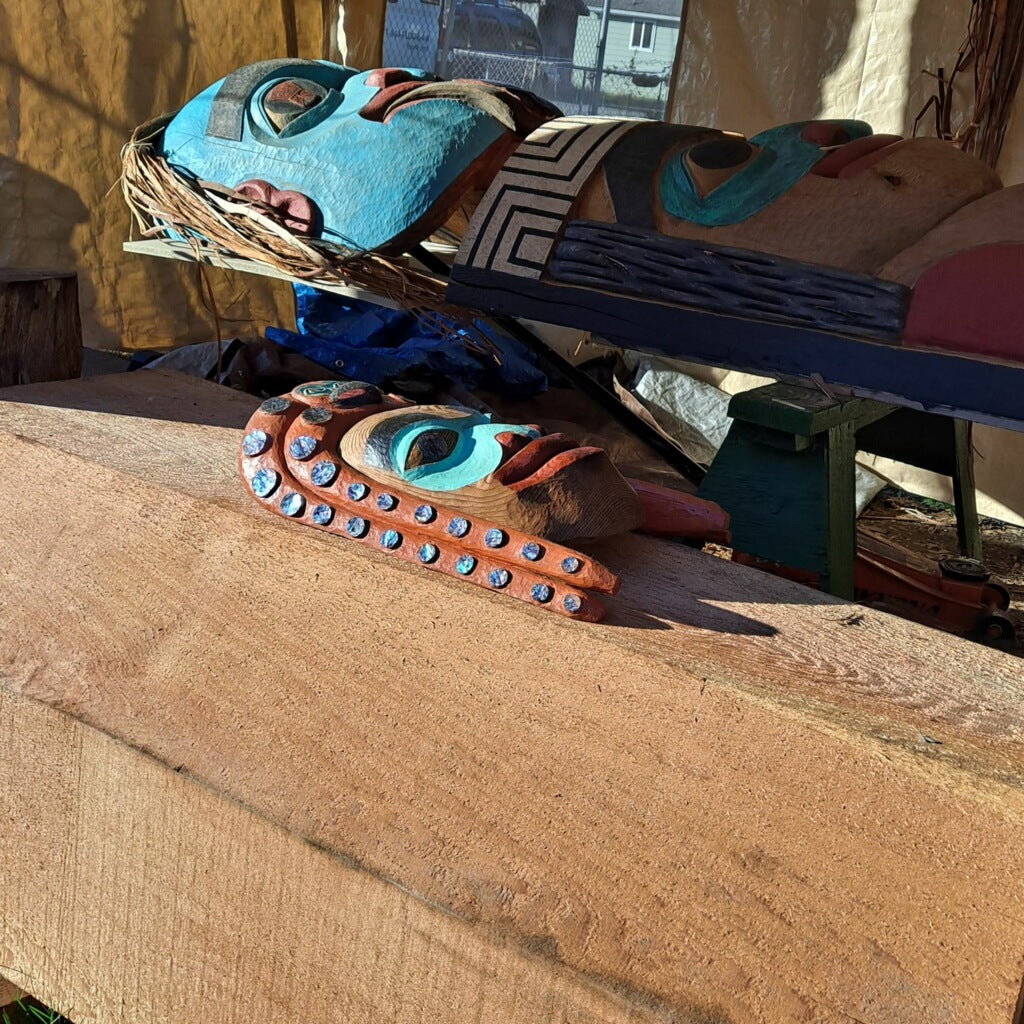
A few years ago, I carved a 17-inch-tall Octopus mask to represent the Chookaneidee Clan, my mother, and my siblings. It turned out pretty good if I say so myself. I used it as a prototype for my larger version. The nice thing about the larger blank in comparison to the smaller prototype is that overall, the larger blank had more wood to work with. This means that I had room for all eight tentacles, in the prototype I could only put 4. I also had more depth to have a more defined face.
The dimensions of the cedar block are 48" tall, 33" wide, and 19" depth. Now I needed to lay the blank onto blocks and level it out, then establish the center line. The thing about working with cedar is that they don't grow symmetrical.
Time to balance the blank from side to side using the center line. On this blank one side had a lot more wood, so I needed to remove more wood on that side to balance the blank. Through a process called faceting, I was able to get the blank balanced and now the fun begins! The cedar wood is ready to have the Devilfish/Octopus design transferred onto it.
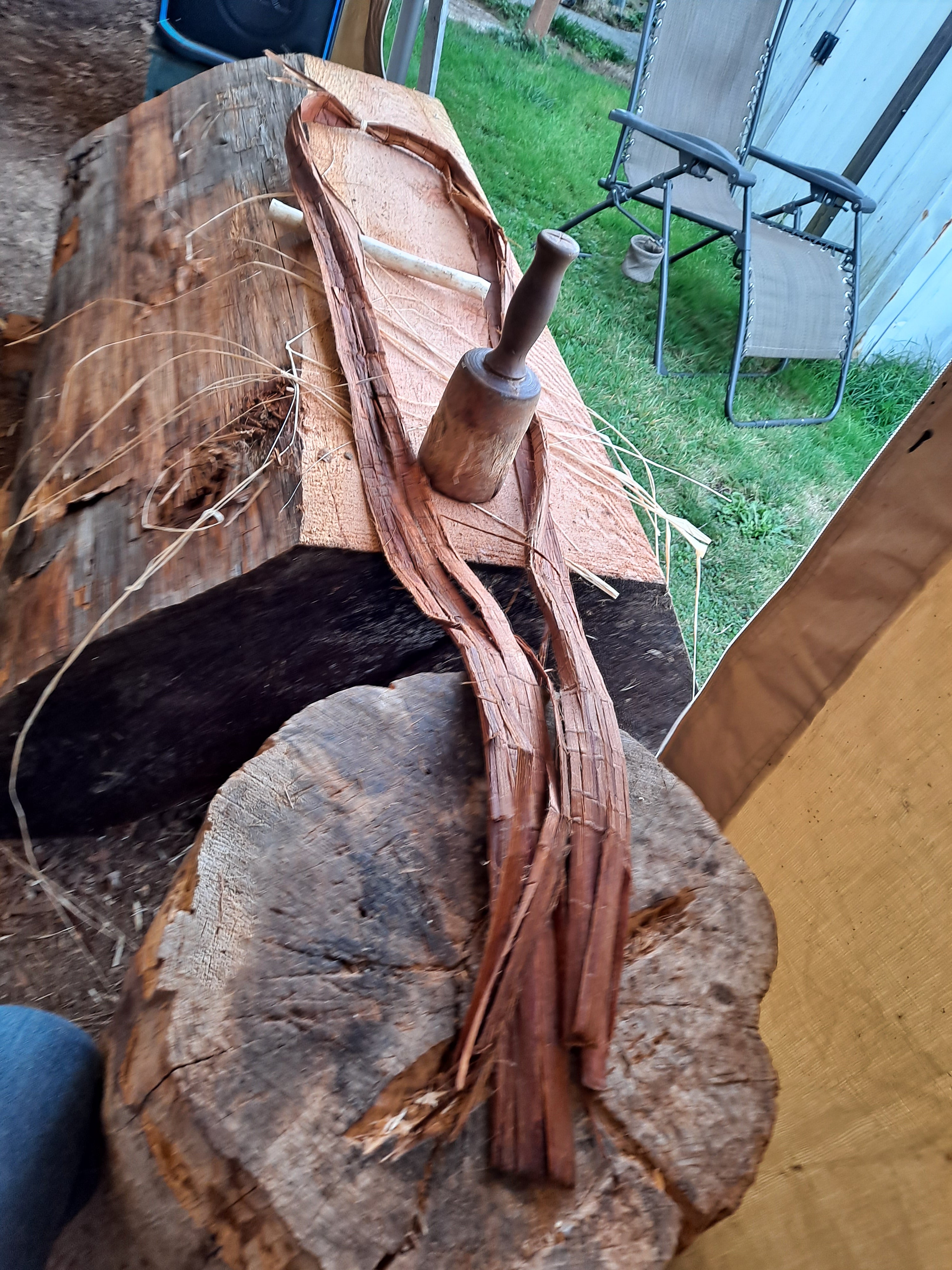
As I was drawing the design, I could see that I had more options than I did with the prototype. I decided to go with a different style of Devilfish/Octopus face for one. The prototype tentacles came down the sides of the face and maintained a straight line like a person's hair would do. I was planning on doing this on the larger mask as well. The thing about options is that they are subject to change. I explain it this way, "My carvings evolve through dreams, visions, and inspiration throughout the process".
I was talking with my wife Ivy about how the mask is coming along. At this point, I had the Tlingit face already getting established and Ivy had an idea about the tentacles. She thought it would look awesome if the tentacles weaved in and out crossing over themselves as they lay along the side of the face! I thought that was a great idea as well, but I wasn't able to make that happen on this piece because establishing the human (Tlinjgit Kaa) face took up a lot of space. There wasn't enough to weave the tentacles. So keeping the tentacles straight seemed like the best option at this point, knowing in the back of my mind its more than likely to change. I told Ivy that I had to carve the Octopus tentacles down to the ear area anyway before deciding.
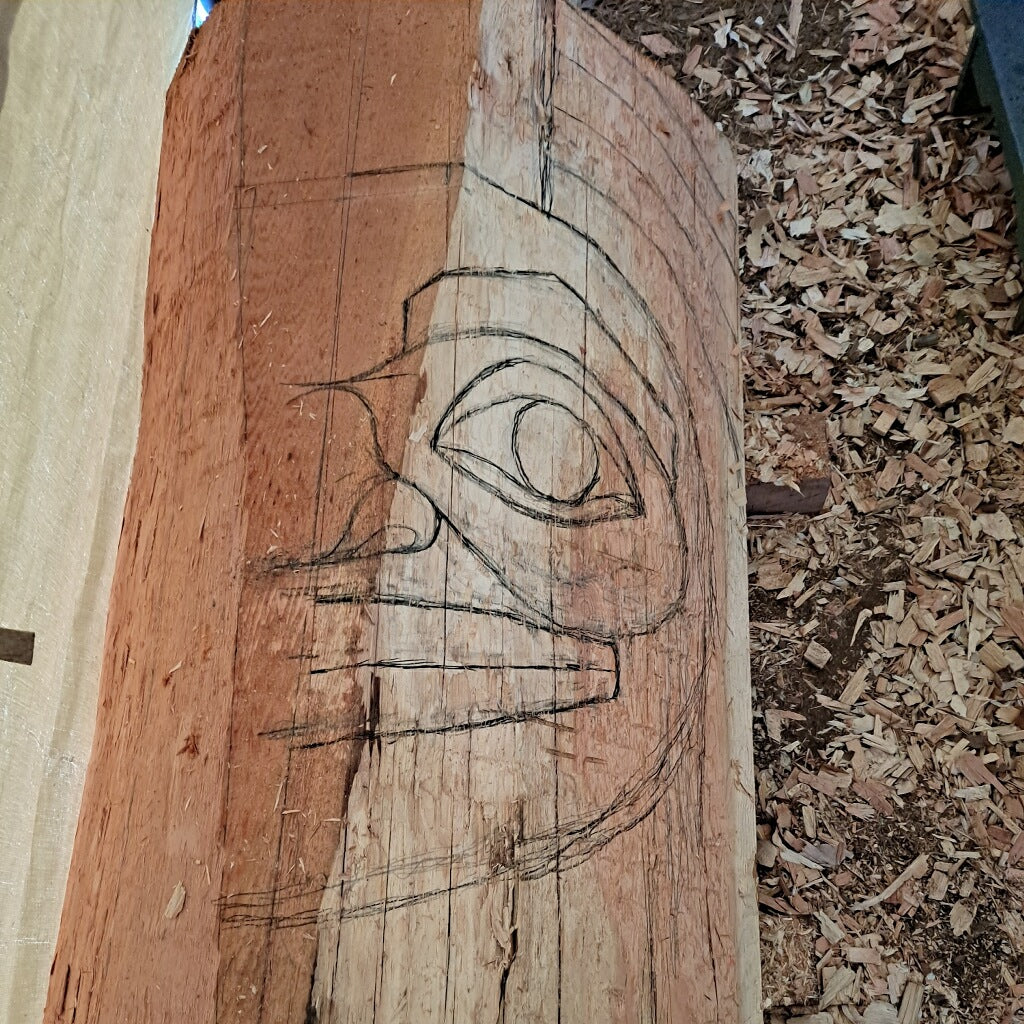
Carving is a process that takes time to evolve, which allows time to think about the options as I carve my way to those critical areas. With that being said, I did look at the tentacles and how they could look along the way, keeping in mind Ivy's suggestion of weaving them in and out.
When I reached the point where I needed to decide how they'd look, I had already been thinking of having the Octopus tentacles swirling in a circle somehow. So I started doodling. Drawing the tentacles and having them swirl in opposing directions L-R-L-R on one side, and R-L-R-L on the other as the available space opened up below the Tlingit Kaa's chin area. This seemed to be the best option.
Before I decided on swirling the tentacles, I should mention that I was looking at keeping the tentacles straight. That meant that there was a lot of wood that was going to have to be removed below the chin (approximately 11x18 inches), leaving the straight hair/tentacles on the sides. That's a lot of real estate (wood) to remove I remember thinking. I had my battery chain saw out and was half a heartbeat away from doing it. I decided not to because when you do that, it means you made a commitment and removed the options. Now if I did remove all that wood and went with the straight hair/tentacles it would have looked good… but instead I went with the swirls, and in the end I am glad I did!! This is the best part of being in what I call the creative zone!! Don't you agree?
Explore my older Blogs from 2009 at fredfulmer.blogspot.com ▶️
Follow along with my journey as a Tlingit artist, carver, and Cultural Bearer — I have documented over 1000 videos of my experiences, carvings, and cultural presentations. Watch them on my YouTube channel: Fred Fulmer Tlingit Artist ▶️.
I also did a Lecture about "How the Chookaneidí Clan Earned the Rights to Use the Devilfish/Octopus as a Crest" at Sealaska Heritage Institute for their Lecture Series September 13th 2022.
"Fred Fulmer has served twice as a Resident Artist at the Burke Museum of Natural History and Culture at the University of Washington."
Collect the Chookaneidee Devilfish
Fred Fulmer brings this ancient clan crest to life in hand-carved cedar, bronze replicas, and collectible keepsakes.
🐙 Bronze Replica 🔑 Key Ring→ View the Totem-Sized Carved Mask